

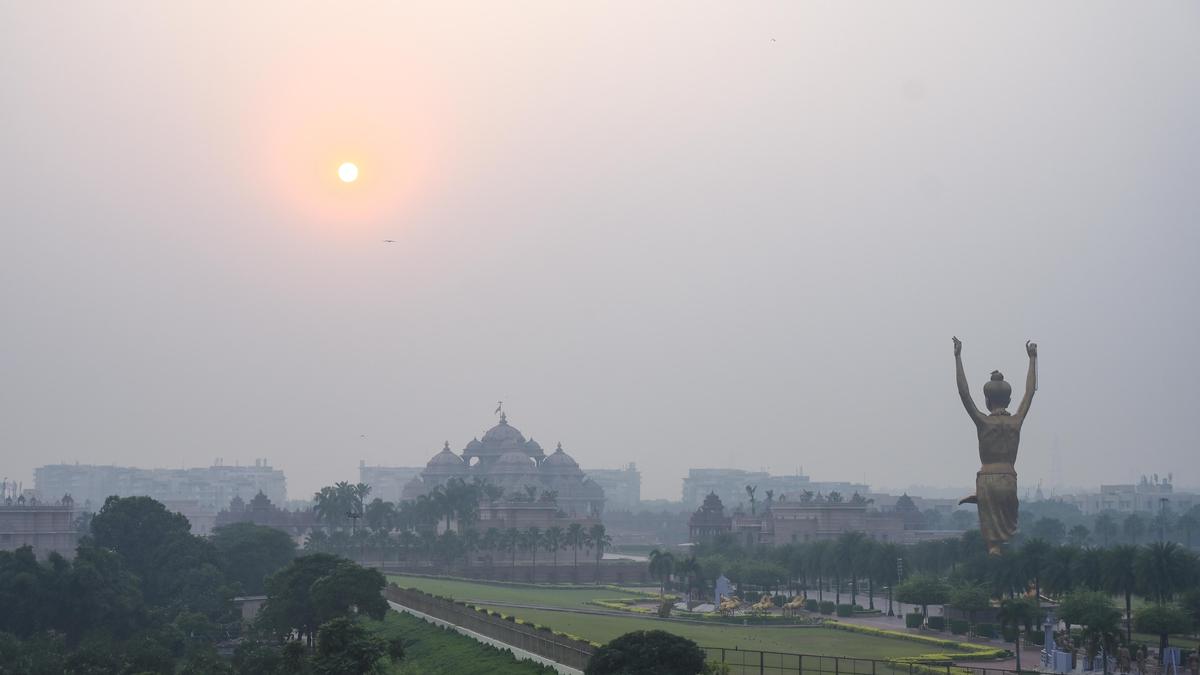
Delhi's air quality deteriorates to 'very poor' for first time this winter, farm fires cited as primary driver
New Delhi — Delhi's air quality index crossed into the 'very poor' category for the first time this winter season on Monday, with the 24-hour average AQI reaching 324 by 4 p.m., the Central Pollution Control Board reported. The reading, up from 261 'poor' the previous day, triggered the invocation of Stage 2 of the Graded Response Action Plan by the Commission for Air Quality Management in NCR and adjoining areas.
Smoke from farm fires in Punjab and Haryana was identified as the primary driver of the pollution spike, according to an analysis of air-quality, weather and satellite data. Most fires were lit in the evening after the NASA satellite whose count is the standard measure of stubble burning had passed over the region, the Hindustan Times analysis found.
Meteorological conditions contributed to the accumulation of pollutants. The night of November 1 saw PM2.5 levels average 194 micrograms per cubic metre from 10 p.m. to 6 a.m., more than three times India's daily limit of 60 micrograms per cubic metre. On October 18 and 28, when similar wind conditions and inversion strength were present, PM2.5 averaged 68 and 127 micrograms per cubic metre respectively — significantly lower, confirming the contribution from stubble burning.
Rain on October 29 and 30 had temporarily cleared the air, with the AQI falling to 60 on Friday. However, as those clean hours dropped out of the 24-hour average, the index rose again. On the night of November 1, fine particles made up nearly six-tenths of all particulate matter by weight, against just over four-tenths on the October nights, indicating smoke as the dominant pollutant source.
The pollution did not thin out during the day as usual. On November 1, PM2.5 was slightly higher in the afternoon than in the morning, readings showed, indicating that extra pollution was blowing in from outside Delhi or that air higher up was as dirty as the air at street level. Around midday on October 31, PM2.5 nearly doubled in three hours, the sharpest midday rise this season.
The Commission for Air Quality Management invoked Stage 2 of the Graded Response Action Plan, mandating enhanced vehicle parking fees to discourage private vehicle use, staggered timings for public offices and municipal bodies in Delhi and NCR districts, and additional Delhi Metro trips. The GNCTD and NCR State governments are also required to implement existing measures such as mechanical sweeping of roads and sprinkling water on roads.
Every winter, air pollution spikes in the Delhi-NCR and many parts of the larger Indo-Gangetic Plains, mainly due to meteorological factors such as lower wind speeds and a drop in temperature. Pollution from stubble burning during October and November and bursting of firecrackers during the festive season also add to existing pollution from vehicles and dust, worsening the air quality. The 24-hour average AQI of Delhi stood at 324 (very poor) at 4 p.m. on November 2, 2026, as per the CPCB's daily bulletin.
'Very poor' levels of air pollution could lead to 'respiratory illness on prolonged exposure', as per the CPCB. On February 11, 2026, the AQI was 305 (very poor).