
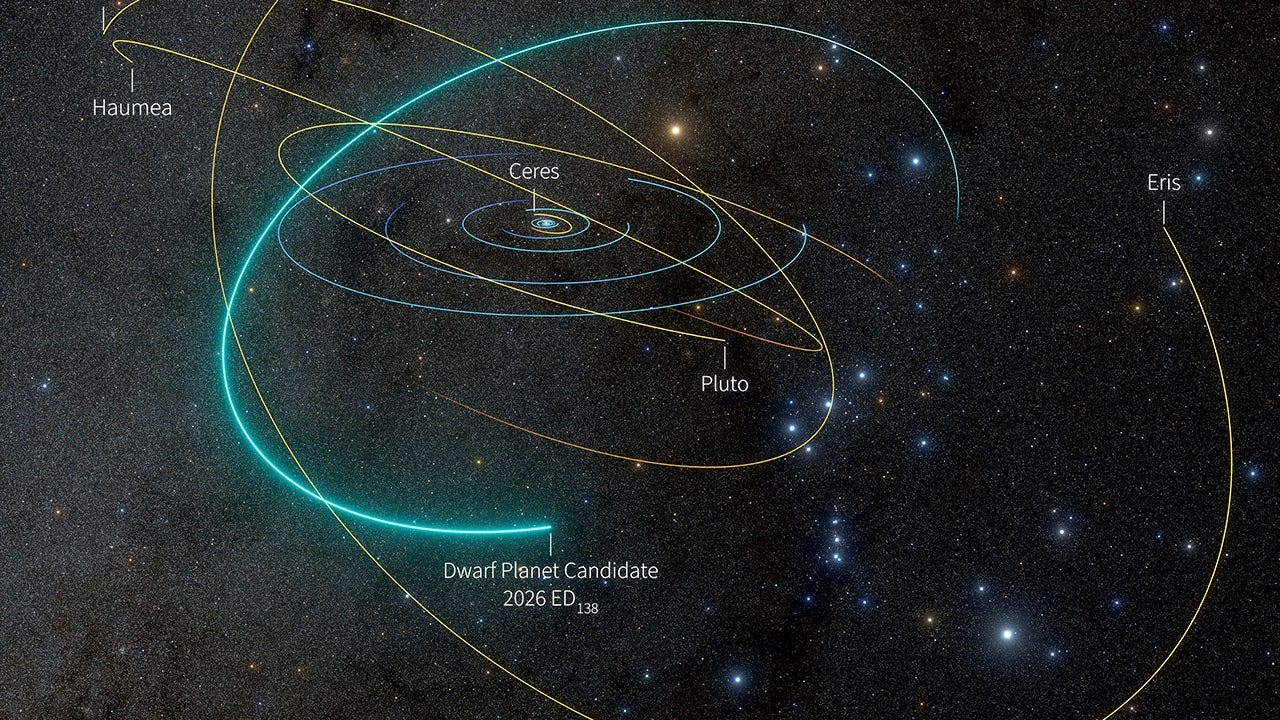

Astronomers using the Vera C. Rubin Observatory have identified a dwarf planet candidate beyond Pluto that could rank among the largest of its kind ever found in the outer solar system.
The object, designated 2026 ED138, was discovered on October 13, 2026, by astronomer Matthew Holman while analyzing telescope data collected earlier in the year. Holman, working with colleague Kevin Napier, immediately recognized the object's unusual size based on its brightness and distance.
ED138 is estimated to measure between 370 and 930 miles in diameter. If confirmed as a dwarf planet, it would join an elite group of worlds in the outer solar system.
The object's previous elusiveness was attributed to its location in a crowded region of the sky near the Milky Way, where millions of stars obscured it from earlier telescopes. The Vera C. Rubin Observatory's wide-field survey capabilities and advanced algorithms enabled the team to penetrate this dense stellar field and identify ED138.
Located approximately 4.3 billion miles (46 astronomical units) from the sun, ED138 orbits beyond Neptune and is classified as a trans-Neptunian object. The discovery highlights the observatory's potential for revealing objects that earlier surveys missed.
Scientists plan further observations to determine ED138's exact size and whether it will be formally classified as a dwarf planet. The Rubin Observatory's 10-year sky survey, which began in June 2026, continues to expand understanding of the solar system's outer regions.
The discovery was announced by the Vera C. Rubin Observatory, jointly funded by the U.S. National Science Foundation and the Department of Energy's Office of Science.