
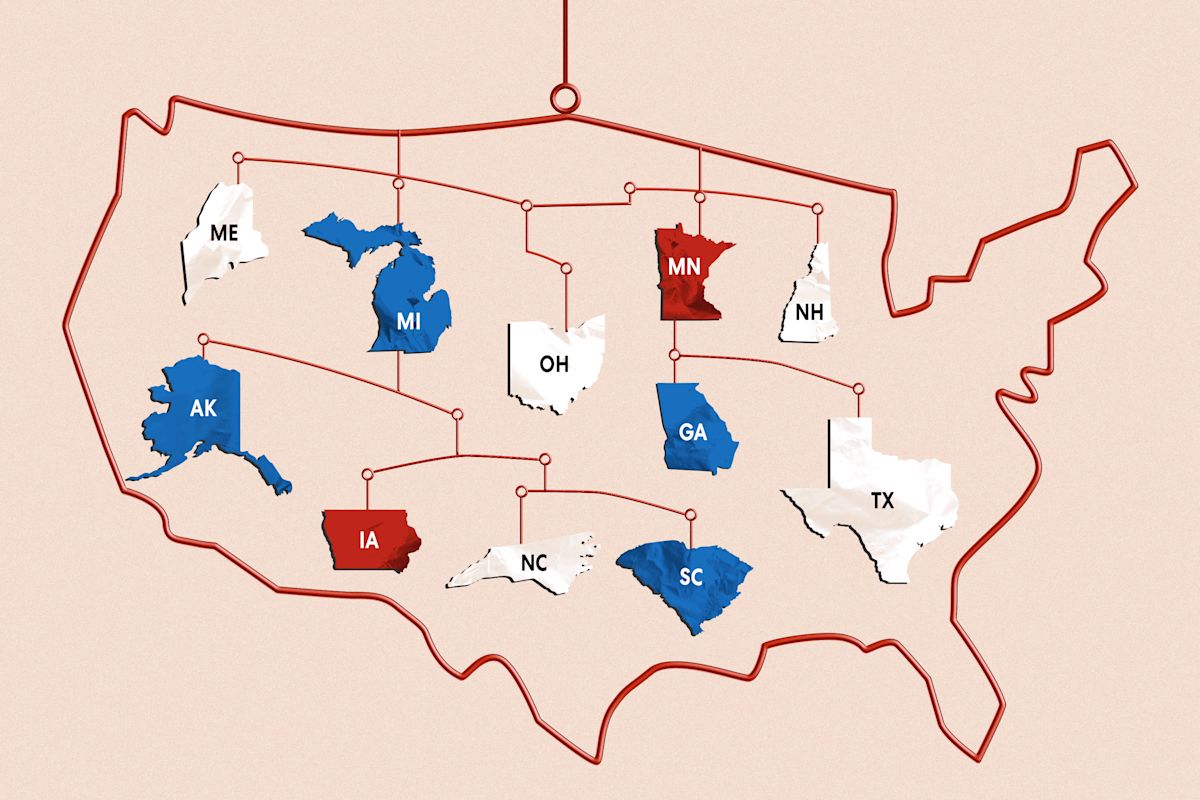
WASHINGTON — With 35 Senate seats on the ballot, control of the upper chamber will be decided by a competitive set of races across states ranging from traditional swing strongholds to areas where one party has rarely been competitive recently.
Republicans enter the 2026 midterms holding a 53-47 majority. Because Vice President JD Vance can break tie votes in an evenly split Senate, the GOP can lose three seats and still maintain control. Democrats need to gain at least one chamber to block or reshape President Trump's legislative agenda for his final two years in the White House. A Senate majority would empower Democrats to reject Trump's nominees for Cabinet and judicial positions and take control of key committees that could launch investigations into the administration.
The competitive Senate landscape includes open-seat contests and rematches across a diverse set of states. In Michigan, Democrat Abdul El-Sayed faces Republican Mike Rogers to replace retiring incumbent Gary Peters, with the race shaped by a competitive Democratic primary won by El-Sayed over a more moderate opponent. In Georgia, incumbent Jon Ossoff seeks reelection against Republican Mike Collins, who rose to prominence after Ossoff's upset victory in a 2020 runoff.
Other competitive races include contests in Iowa, where Democrat Josh Turek challenges Republican Ashley Hinson in a state that has shifted right; Kansas, where Democrat Adam Hamilton challenges Republican Roger Marshall; and Maine, where Republican Susan Collins faces Democrat Troy Jackson. Open-seat contests in North Carolina and Ohio also feature competitive matchups, with Libertarian and third-party candidates on the Ohio ballot potentially influencing a tight race.
In Alaska, Republican Dan Sullivan faces a challenge from former Rep. Mary Peltola, the first Alaska Native and first woman to represent the state in Congress. The race attracted national attention after the Department of Justice filed a lawsuit alleging a second Sullivan on the ballot was a Democratic plant to confuse voters; a federal judge dismissed the lawsuit, though the DOJ said it plans to appeal.
Forecasters view the Senate as a true toss-up, with outcomes in roughly a dozen competitive states likely to determine which party controls the chamber. The results will have significant implications for the balance of power in Washington through the remainder of the current administration.