
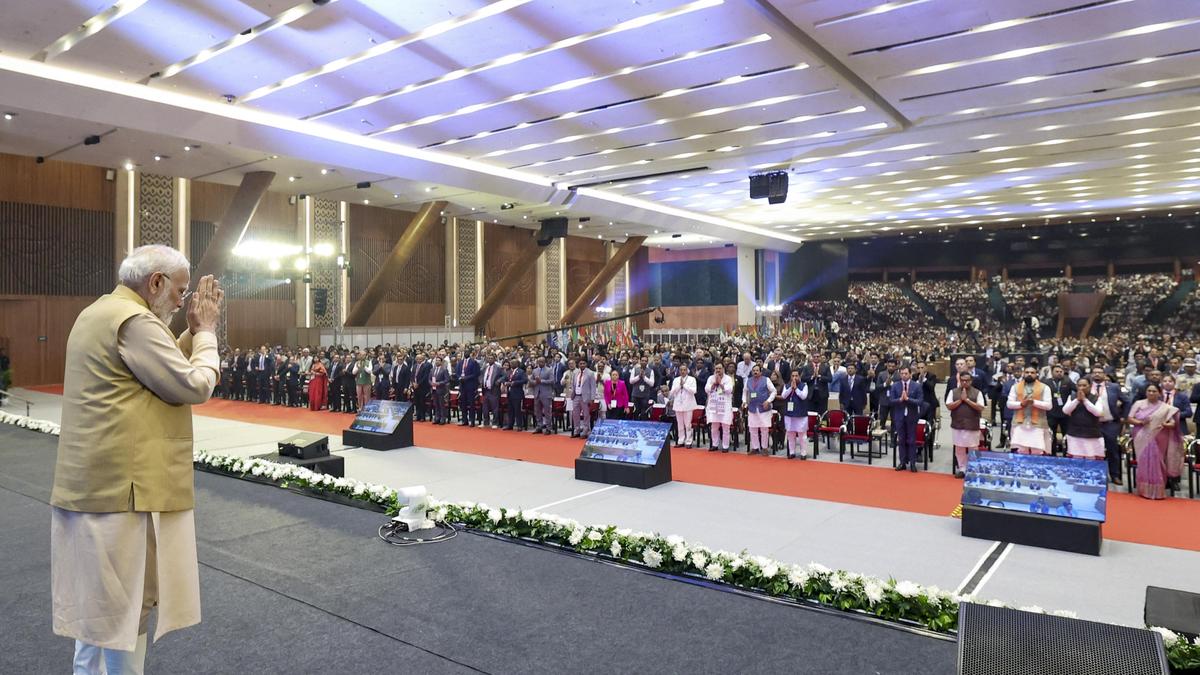

NEW DELHI — Prime Minister Narendra Modi used the Bharat Renewable Energy Summit & Expo 2026 to frame India's clean energy transition as a cornerstone of national economic security, stating that investments in renewables over the past decade have insulated the country from the worst impacts of global crises.
Modi said the West Asia conflict and the Covid-19 pandemic demonstrated how closely energy security is linked to economic stability, and that continued dependence on fossil fuels could disrupt the global economy. "If we continue to rely heavily on fossil fuels, then the global economy will continue to be disrupted. Because the stockpile of fossil fuels is limited in some regions, but the potential of renewable energy is unlimited," Modi said, adding that the future of energy security lies in clean energy.
India achieved its Paris Agreement commitment of sourcing 50% of installed power capacity from non-fossil fuel sources in 2025, five years ahead of the 2030 deadline. Non-fossil sources now account for more than half of India's installed power capacity, which has reached nearly 300 gigawatts. The country is working toward a target of 500 GW of non-fossil fuel capacity by 2030 and aims to add another 500 GW over the next 10 to 11 years.
The prime minister highlighted the PM Surya Ghar Muft Bijli Yojana, launched in February 2024 with a target of covering one crore households. More than 65 lakh homes have been connected under the scheme, with beneficiaries seeing a 76% reduction in their electricity bills. Under the PM-KUSUM scheme, solar installations are benefiting more than 30 lakh farmers, generating estimated annual savings of Rs 1 lakh per farmer. Solar systems installed at over 44,000 government buildings are also saving around ₹700 crore annually.
Modi said India's solar module manufacturing capacity increased from 2 GW a decade ago to more than 200 GW, while solar cell manufacturing capacity reached 40 GW. The renewable energy sector has attracted investments worth more than Rs 15 lakh crore (USD 164 billion) over the past decade. Since the ReInvest summit in 2024, investments of around Rs 6 lakh crore (over USD 63 billion) have been seen in just two years, with estimates suggesting over Rs 20 lakh crore (about USD 220 billion) in investment opportunities by the end of this decade.
Under the National Green Hydrogen Mission, the goal is to produce 50 lakh tonnes of green hydrogen by the end of this decade, Modi said. The summit coincided with the ninth Assembly of the International Solar Alliance and the fourth International Green Hydrogen Conference.
Modi called for healthy competition among states and local bodies on renewable energy adoption, suggesting every government building, school, college, hospital, and the entire street lighting network be connected to solar energy at a rapid pace.