


NEW YORK/SEOUL — President Lee Jae Myung of South Korea unveiled the country's largest-ever budget on Monday, pitching a record 820.9 trillion won ($610.14 billion) spending plan for 2027 that leans heavily into artificial intelligence and semiconductor development as the twin engines of future growth.
The address to the National Assembly marked a significant escalation in South Korea's AI investment strategy. Lee announced 21.3 trillion won for semiconductors, physical AI and AI data centers — nearly double the 2026 level — alongside a separate 4.7 trillion won allocation for development of a sovereign AI model described by the president as having "world's highest performance." The investment comes as global demand for computing power accelerates with the AI boom, and South Korea's semiconductor exports have become a critical barometer of the technology cycle.
"We will make bold investments in AI and future growth engines to boost our economy's growth potential," Lee said, adding that the spending package would position South Korea at the forefront of AI development.
The budget also includes significant human capital measures. The government plans to train 2,000 specialists to "lead semiconductor design and the regional semiconductor industry," while expanding AI education for students, job seekers and existing workers. A notable initiative involves university "contract departments," where students enroll in company-linked degrees that offer pathways to jobs at firms like Samsung Electronics and SK Hynix before graduation. Corporate partners help design courses, provide financial support and recruit qualifying graduates.
On the military side, defense spending increases 8.2% to 73.3 trillion won, with Lee stating the government will "rapidly transform into a smart, elite, and powerful military by establishing a hybrid manned and unmanned system based on AI, robots and drones." The budget aims to secure nuclear-powered submarines and KF-21 fighter jets amid regional security dynamics.
The record spending plan arrives against a backdrop of strong economic performance. October export data released Sunday showed shipments surging 93.7% year-on-year to $115.3 billion, a new high that pushed total exports to $930 billion in the first 10 months of 2026 — surpassing the $900 billion mark for the first time. The country posted a $42.5 billion trade surplus in October, with imports rising 36% year-on-year to $72.8 billion. Lee cited this performance, noting South Korea was within reach of $1 trillion in annual exports.
Lee framed the higher spending as achieving "virtually no net increase in government debt," with newly issued bonds used to repay existing obligations. The International Monetary Fund had previously forecast 3.3% economic growth for 2026, its fastest pace since the post-pandemic rebound in 2021.
The budget also earmarks 2.1 trillion won for electricity, water supply and industrial complex infrastructure, acknowledging that semiconductor plants require a stable power supply around the clock. The government had previously announced a 162.3 trillion won "Future Fund" to channel record tax revenues from the chip boom into long-term growth.
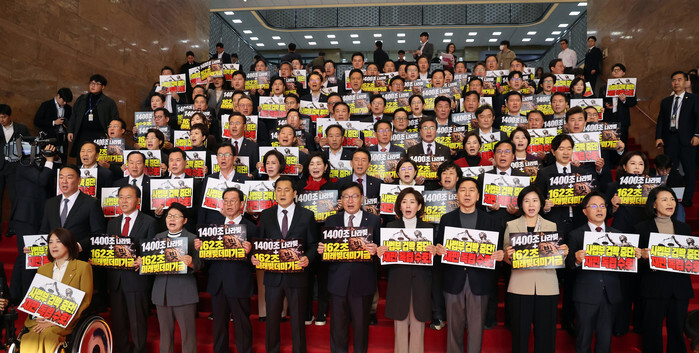
The presentation faced intermittent heckling from opposition lawmakers, though Lee maintained his composure and concluded his speech. The budget proposal now moves to parliament, where the president's party holds a majority, making passage likely.
South Korea's strategy reflects the government's assessment that AI and semiconductor leadership are essential to sustaining the country's economic momentum and technological competitiveness in an increasingly AI-driven global economy.