
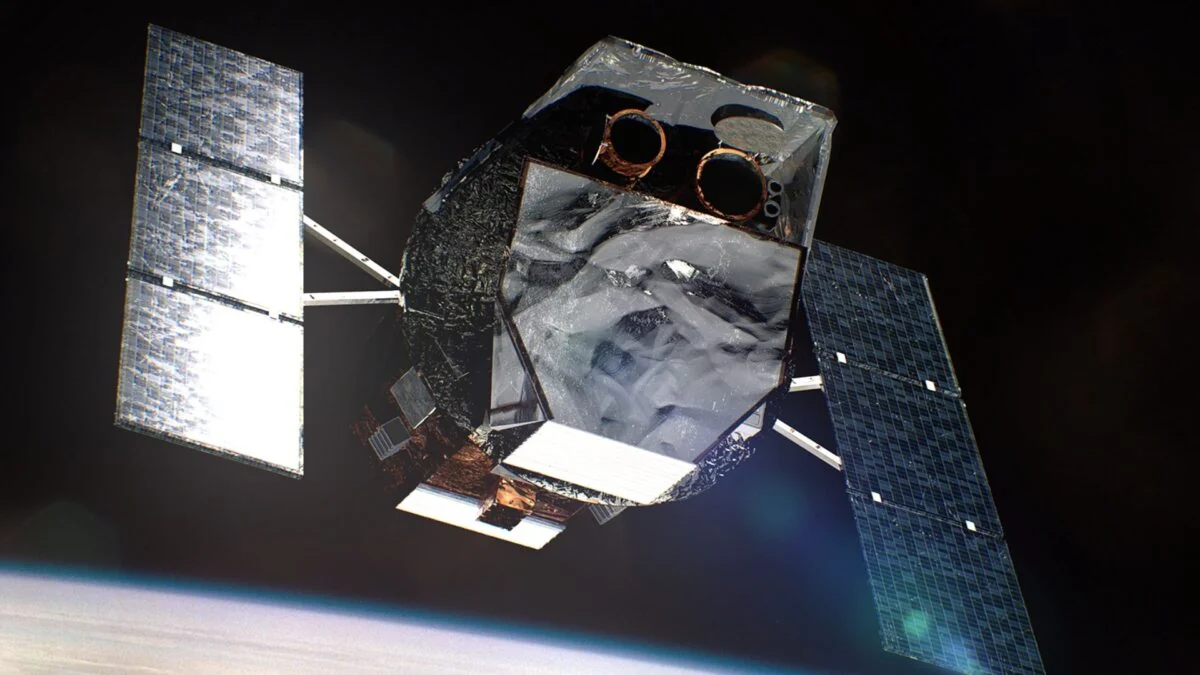

CAPE CANAVERAL, Fla. — NASA's Neil Gehrels Swift Observatory is expected to reenter Earth's atmosphere between Tuesday and Wednesday of this week, marking the end of one of the most successful astronomy missions in history.
Launched in November 2004 on a Delta II rocket with a planned two-year lifespan, the satellite operated for nearly 22 years, far exceeding its original objectives. During its mission, Swift studied over 2,000 gamma-ray bursts, more than 1,400 supernovae, and other cosmic phenomena that resulted in approximately 7,000 published scientific papers.
The observatory's descent was accelerated by recent spikes in solar activity. In September 2025, NASA enlisted Katalyst Space Technologies of Flagstaff, Arizona, to launch the LINK mission to boost Swift into a higher orbit and extend its operational life. The mission launched in July but was abandoned in October after the robotic satellite experienced attitude control issues while en route to the observatory.
As of October 23, Swift's orbit had decayed to less than 171 miles (275 kilometers) above Earth, according to NASA and U.S. Space Force tracking data. The satellite's orbital inclination of 20 degrees north and south of the equator means debris could fall within a broad band covering Africa, Australia, India, Southeast Asia, and Central and South America.
Most of the 1.5-ton satellite will burn up during reentry, but astrophysicist Jonathan McDowell estimates at least 100 kilograms (220 pounds) of dense components, including telescope mirror equipment, may survive the fiery descent. McDowell calculates the risk to any individual at approximately one in 10,000, noting that since the Sputnik era, about 10,000 reentries have occurred with no confirmed injuries to date.
Given the uncertainty of the reentry time and location, officials say it is extremely difficult to forecast where surviving pieces might land. Most of the reentry zone consists of ocean, but densely populated areas within the band could be affected. Scientists view the event as a valuable opportunity to study which components withstand reentry temperatures, which could inform safer satellite design and help assess impacts on atmospheric chemistry and the ozone layer.
‘Obviously a lot of that latitude band is ocean,’ McDowell said. ‘That’s where any surviving components of Swift are most likely to land.’
While the risk to individuals is extremely low, the event highlights growing concerns about uncontrolled space debris reentries as orbital traffic increases. This mission's conclusion also marks the end of a mission that fundamentally transformed the study of gamma-ray bursts and other high-energy astrophysical phenomena.
‘We’re all going to pour one out for Swift,’ McDowell said.