

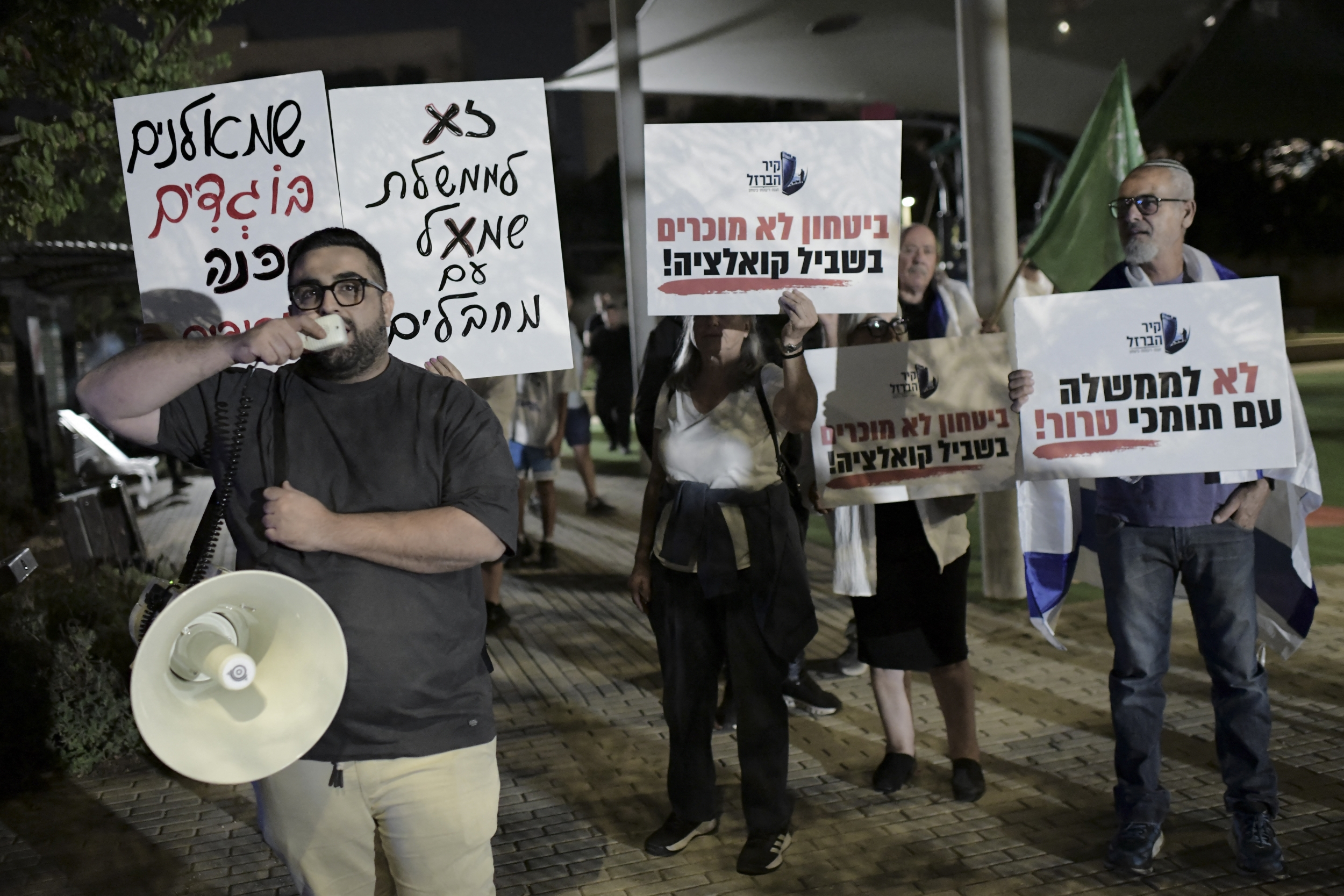
JERUSALEM — Right-wing activists staged protests outside the home of former IDF Chief of Staff Gadi Eisenkot on Sunday, shouting that he murdered his son and calling him a traitor, in a demonstration that crossed into deeply personal grief outside the politician's Herzliya residence.
The protests, organized under the banner "No to a government with terror supporters," drew dozens of demonstrators to Eisenkot's private residence. One protester used a megaphone to shout at Eisenkot's wife: "Your husband is a traitor... he murdered your son." The demonstrators referenced Master Sergeant Gal Eisenkot, who was killed in combat in Gaza in December 2023.
The demonstrations occurred against the backdrop of Israel's post-election political deadlock following the October 27, 2026 Knesset elections, which produced a fragmented result with neither major bloc achieving a majority. Final certified results showed Likud claiming 27 seats and Eisenkot's Yashar party taking 21, while Naftali Bennett's Together bloc won 12. Among Arab-identified parties, the Joint List secured 11 seats and Ra'am eight. Netanyahu's combined right-religious bloc sits at 53 seats; Eisenkot's four-party opposition alliance at 48 — both well short of the 61-seat threshold required to form a government.
The 19 combined seats held by the Joint List and Ra'am place those parties in the position of kingmakers. For Eisenkot, the arithmetic offers one clear path: a deal with both Arab parties would yield a 67-seat governing majority — enough to govern comfortably. Without them, there is no government. Before the election, Eisenkot set three conditions for any potential coalition partner: acknowledgment of Israel as a Jewish and democratic state, acceptance of the values enshrined in the Declaration of Independence, and commitment to military service obligations. His opposition alliance had positioned itself as a bloc seeking a governing majority within Zionist parties alone. That posture is now colliding with electoral reality.
The demonstration is a direct product of the deadlock produced by the October 27 elections. While right-wing groups descended on Herzliya on Sunday, thousands had gathered in Tel Aviv's Habima Square demanding a Jewish-Arab partnership government, with some calling it a last opportunity for democratic renewal. At a separate pro-Netanyahu rally, counter-protesters called for the election results to be annulled entirely and a new vote held.
The confrontation outside Eisenkot's home underscores a country engaged in a raw argument not only over who should govern, but over what Israeli democracy is meant to be — and whether Arab citizens belong inside the tent of power or permanently outside it. Eisenkot had not issued a public response as of Sunday night.
The protests sparked sharp condemnation across the political spectrum. Eisenkot's party issued a statement saying the attack was "a direct result of rotten, unrestrained political leadership that has erased all red lines to remain in power." Former Prime Minister Yair Lapid questioned "what is Jewish about them" and called for leading Israel on a new path. Democratic Party chairman Yair Golan stated the incident was "the poison that Netanyahu and his people are spreading" and called for an end to the "regime of incitement." Former PM Naftali Bennett announced he would recommend Eisenkot to President Isaac Herzog to form the next government.