
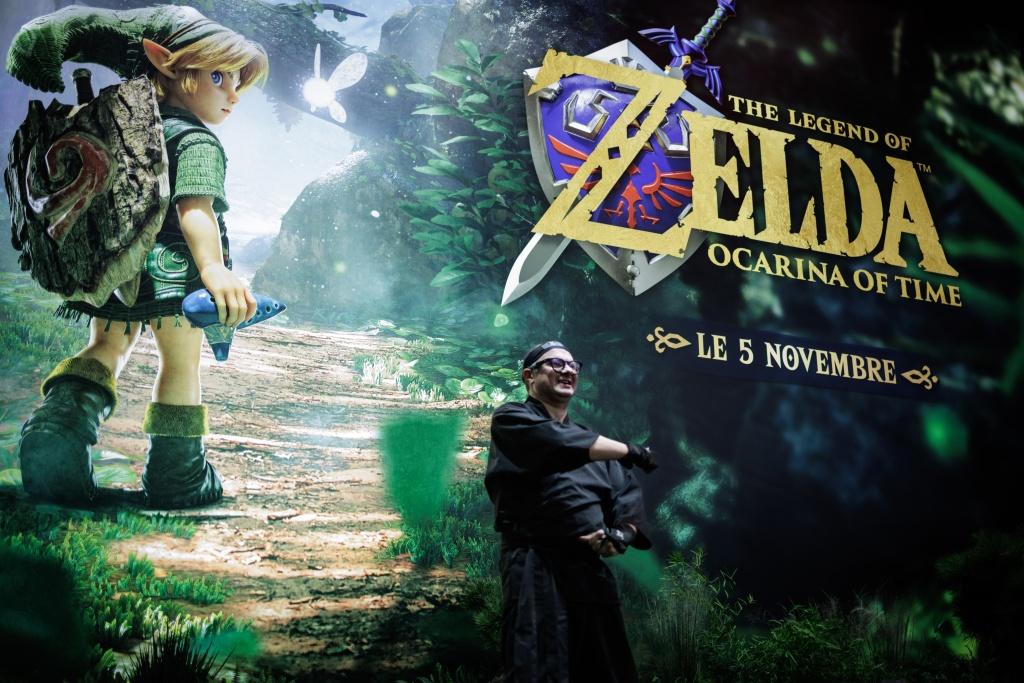


TOKYO — Nintendo released a full remake of The Legend of Zelda: Ocarina of Time for Nintendo Switch 2 on November 5, positioning the 1998 classic as the centerpiece of the console's launch window and the franchise's 40th anniversary celebrations.
The remake, developed by Nintendo's Eiji Aonuma and Hidemaro Fujibayashi, goes beyond a visual upgrade, rebuilding core systems while preserving the exploration philosophy that defined the original. Aonuma, who joined the original development partway through, wanted newer team members to understand how the game's structure shaped the entire series — particularly the balance between guided progression and player discovery.
"I wanted the team to make Ocarina of Time their own," Aonuma said in an interview conducted before the game's release. "By learning the game structure and development style behind the original, and by actually rebuilding it as a full remake, it may trigger new insights that they can carry forward into future development."
The original, released for Nintendo 64 in 1998, was a landmark in 3D game design. It introduced Z-targeting — a system allowing players to lock the camera onto enemies using the Z Button — and established Link's journey between childhood and adulthood forms. For Fujibayashi, who first played on launch day, the system was a revelation in solving the era's fundamental challenge of camera orientation in three-dimensional space.
The remake brings the 28-year-old title into the modern era with 4K resolution when docked, a stable 60 frames per second, and variable refresh rate support. But the most significant changes are systemic. Aonuma initially proposed adding warp points and fast-travel stations similar to those in Breath of the Wild, arguing that players accustomed to open-world freedom would benefit from streamlined traversal. After playtesting, however, the team realized the warp points diminished the moments of discovery that come from stopping along the way and wondering what lies ahead. The warp points were removed entirely.
Instead, the remake adds a dedicated sprint button, allowing Link to cover ground quickly without the forward-roll spamming that defined movement in the original. Epona, Link's horse, is available at Lon Lon Ranch. The remake also features free 360-degree camera control, a real-time day-night cycle across all of Hyrule, and the removal of loading screens that once interrupted transitions into building interiors.
Dungeons have been thoughtfully reworked. In the Great Deku Tree, lowering a ladder now requires activating a physics-driven pulley system via an eye switch rather than simply firing the Fairy Slingshot. The Forest Temple includes a torch-lighting puzzle added to the turnstile mechanic, and a lift installed in the center of the temple shaft makes it easier to move between levels. Combat encounters, such as the battle against Poe Sisters, have been given more dynamic animations.
On the presentation side, character models retain the exaggerated eyes and jawlines reflecting Shigeru Miyamoto's puppet-theatre aesthetics but with far greater detail. Link's eyes now follow objects and characters around him, and his movements have a more natural quality. A new radial menu and quick-swap system reduces the need to open the main inventory during exploration and combat. The ocarina, central to the game's puzzle and music mechanics, can now be played by humming or whistling into the Nintendo Switch 2 microphone, or with physical instrument accessories.
The design philosophy throughout reflects a central tension: how to modernize a classic without erasing what made it enduring. The team landed on enhancements that respect the original's pacing — particularly the value of unhurried exploration — while upgrading controls and presentation for contemporary audiences. The result is a remake that honors the source material not by preserving it unchanged, but by reaffirming why its principles remain relevant nearly three decades later.
The Legend of Zelda: Ocarina of Time is available now on Nintendo Switch 2, priced at the standard premium release tier.